

Why migration matters in Nepal
Nepal has limited formal employment opportunities compared with the size of its working-age population, particularly in rural areas. For many people, overseas employment offers an opportunity to support their families and build financial security. As a result, labour migration has become an important livelihood strategy for millions of Nepalis, while the money migrant workers send home contributes around one quarter of Nepal’s Gross Domestic Product (GDP), making remittances one of the country’s most important sources of income.
Behind these figures are millions of individuals and families making difficult decisions. For many, migration is not simply a choice but a necessity, driven by the limited employment opportunities at home and the desire to provide a better future for their families. However, the migration journey can also bring financial, social and emotional challenges before departure, during employment abroad and after returning home. Many workers leave after taking on high-interest loans to cover recruitment costs, spend years separated from their families and may return home facing debt, unemployment, trauma or uncertainty about their next steps. Without the right support and opportunities at home, some feel they have little choice but to migrate again.
3.5 million +
Estimated Nepalis working abroad, around 14% of the population
792,187
Work permits issued in tax year 2025/26 (88% men / 12% women)
2000+
Nepalis leaving every day for overseas employment
Millions of families
Depend on remittances for daily needs, education and healthcare
25%
Approximate contribution of remittances to Nepal’s GDP. Nepal is among the top ten most remittance-dependent nations globally (ranked number 4 in 2024)
Thousands of workers
return every year
Why we chose this focus (as our first programme)
When Joe and Amandine returned to Nepal in 2025, they did not return with a programme already defined. Instead, they spent time listening to local organisations, community members and people with experience of Nepal’s development and humanitarian landscapes to better understand the challenges communities face and where a small organisation could make a meaningful contribution. Through these conversations, one area gradually became clearer: supporting people throughout the migration journey.
To better understand these experiences, we also spoke with Nepali migrant workers currently working abroad to learn more about what drives migration and how people could be better supported through the whole process. Many shared that, if sustainable livelihoods and opportunities were available in Nepal, they would choose to build their futures alongside their families at home. However, financial pressures, limited employment opportunities and existing debt can leave some people feeling that migrating or remigrating is their only realistic option.
We believe everyone should have the opportunity to build a secure future without becoming trapped in cycles of migration driven by financial hardship. Migration itself is not the problem. The challenge is ensuring people are well prepared before they leave, supported while they are away and able to rebuild sustainable futures when they return home. Our aim is not to prevent migration, but to help make it safer, better prepared and more likely to create lasting opportunities for individuals, their families and their communities.
A typical migration journey
For many Nepali workers, migration begins with a difficult decision. Some leave after taking on significant loans to cover recruitment costs, often paying high interest rates that can take years to repay. Once abroad, many work long hours away from their families, sending money home to support everyday needs, education and healthcare. Returning home can bring new challenges. Some return with limited savings, ongoing debt, skills that are not easily recognised, stress, emotional challenges and uncertainty about what comes next. Without support to plan ahead, reintegration support, access opportunities and rebuild sustainable livelihoods, some people may feel that migrating again is their only realistic option.
Our first planned programme: Return Ready Nepal
Once Ready Nepal Organisation is established, our first planned programme will be the Return Ready Nepal.
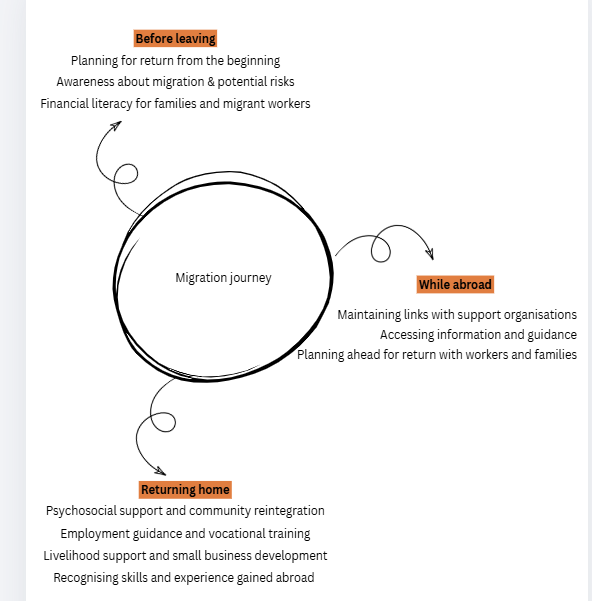
Return Ready Nepal aims to support people throughout the whole migration journey. This will include helping them prepare before migration, plan for their future while abroad and rebuild sustainable livelihoods when they return home. Rather than focusing on only one stage of migration, the programme will connect different types of support across the migration cycle, recognising that decisions made before departure can influence outcomes years later.
Nepal already has government services and civil society organisations working to support migrant workers, and their contribution is essential. However, from our research and conversations, we found that gaps remain in providing continuous support throughout the migration journey, from helping people make informed decisions before departure to building sustainable livelihoods after they return.
Return Ready Nepal aims to work alongside existing organisations, building partnerships and contributing where additional support is needed. Over time, we hope to strengthen connections between organisations supporting migrant workers overseas and those supporting them in Nepal, building a more continuous process for those in the migration journey.
Looking ahead
Return Ready Nepal will be our first programme, but we hope it will not be our only one.
As we build relationships and continue listening to communities, we aim to develop additional programmes that respond to priorities identified through our work on the ground and by the people we work alongside. While our first focus is supporting migrant workers and returnee communities, our longer-term ambition is to strengthen resilience more broadly by developing practical, locally led programmes shaped by community needs and helping Nepal prepare for future challenges.